


Sunlife Sun MaxiLink Prime Review: What I Was Promised vs. What I Actually Got After 7 Years


Back in 2019, when I signed up for SunLife's Sun MaxiLink Prime, I wasn't really thinking about insurance at all. Honestly, I was thinking about money growth.
I had some savings just sitting in the bank doing basically nothing, and my advisor made this pitch that instead of letting it earn peanuts, why not put it somewhere like SunLife where it could actually grow? The life insurance part felt like a bonus, not really the reason I said yes.
Fast forward seven years, and funny enough, that's flipped completely. A lot of you already know my son is on the autism spectrum, and that I'm the breadwinner in our home. I didn't really connect those two things to this policy when I signed up, if I'm being honest.
But now, after watching this fund grow way slower than I was told it would, the thing I actually appreciate most isn't the investment side anymore. It's knowing that no matter what happens to me, there's a guaranteed amount waiting for my son. That's really what this Sunlife Sun MaxiLink Prime Review is really about.
So What Is Sun MaxiLink Prime, Really?
In the simplest terms I can put it: it's two things bundled into one. Life insurance, plus an investment fund. Part of what you pay goes to insuring your life and health, and the rest gets invested in things like bonds and equities so it can grow. The idea is you pay for at least 10 years, and after that, the policy is supposed to sustain itself without you needing to add more.
What They Showed Me vs. What Actually Happened
Here's the comparison I really wish someone had walked me through more honestly back in 2019. Now that I actually have seven years of real numbers, I can finally put it next to what was originally promised.
What was presented to me:
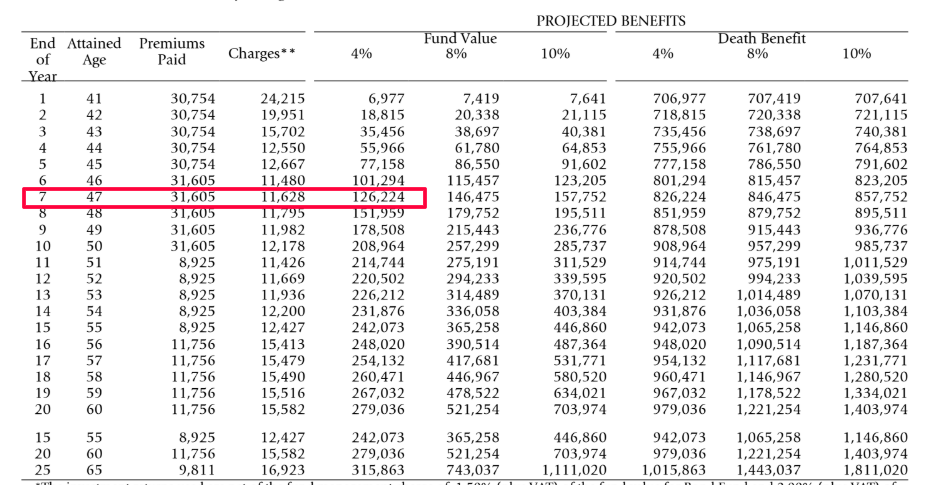
What actually happened:

Now look, I get that growth rates in a proposal are just assumptions, not guarantees. I knew that going in. What I genuinely didn't expect was an actual loss.
There's a big difference between "it might grow a bit slower than we projected" and "your equity fund is down 25% after five years." Nobody puts that on a slide during the sales pitch, but that's exactly what happened to mine.
And here's something I think is worth saying clearly: this isn't just a SunLife thing. I have another VUL with AXA, and I've seen the same pattern there too, equity performance nowhere close to what was assumed when I signed up.
So I'm not writing this to drag one company. Honestly, this feels more like a VUL industry thing, or maybe just a market reality thing, than something specific to Sun MaxiLink Prime.
Before You Sign Anything, Ask This One Question
If you take away just one thing from this post, let it be this: don't just look at the projected growth rate on the proposal. Ask your advisor to show you the fund's actual historical performance, from when it started up until now, especially for the Equity Fund.
Here's why I feel strongly about this. If an advisor is still showing you something like a 4% growth assumption while the actual fund has been posting losses for years, that's a real problem. Not a "maybe it underperformed a little" problem, an honesty problem.
A projection can be optimistic, sure, but it shouldn't be completely disconnected from what the fund has actually been doing.
Some questions I wish I'd asked back then:
What has this specific fund actually returned each year for the past 5 years, not just an average?
Is that 4% (or whatever number is on my proposal) based on real historical performance, or is it just a standard industry assumption?
Can you show me how this fund did during a bad year, not just the good ones?
In actual pesos, how much of my premium goes to riders and fees versus the investment itself?
You have every right to ask these before signing anything. A good advisor won't flinch. If they can't or won't show you real numbers, well, that tells you something too.
What If I'd Just Put the Money in Pag-IBIG MP2 Instead?
This is the comparison I really wanted to run for myself. If I'd taken that same ₱31,605 a year and just put it into Pag-IBIG MP2 instead, would I be better off right now?
Quick disclaimer before I show you the numbers: MP2 dividend rates change every year, so this is just an illustrative estimate using a flat average rate, not an exact historical calculation.
I'm not a financial advisor, so take this as a rough side-by-side, not gospel. If you want the real precise numbers, Pag-IBIG publishes their actual yearly dividend rates on their site.
Assuming ₱31,605 contributed once a year for 7 years, compounded annually:
Even on the conservative end, MP2 would've likely blown past my VUL fund value. That's not a small gap, that's a pretty painful one to look at.
But I do want to be fair here, this isn't really apples to apples. MP2 has zero insurance component.
If something happened to me tomorrow, MP2 would only give my son whatever I'd put in plus dividends, nothing more.
My VUL, on the other hand, guarantees at least ₱700,000 (double my base face amount) plus riders for critical illness, hospital income, and disability, no matter what the fund is doing.
That guarantee is honestly the whole reason I'm still keeping this policy, even knowing MP2 probably would've grown my money faster.
Okay, But Is Sun MaxiLink Prime Actually Worth It?
Even with all the fee and market disappointment, there's real peace of mind here, and for me, that peace of mind is 100% about my son.
The Double Death Benefit: My coverage is guaranteed at least double my base face amount. With a ₱350,000 base plan, that's a guaranteed ₱700,000 minimum for my family, plus whatever's in the fund at the time.
Critical Health Protection (riders): My Critical Illness Benefit gives a lump sum of ₱350,000 if I'm diagnosed with something major. The Hospital Income Benefit adds ₱1,700 a day if I'm confined. Knowing a medical emergency won't force me to dip into my son's "life fund", that's a real relief.
Accident and Disability Coverage: There's also an extra ₱350,000 for accidental death, dismemberment, or disability (ADDD), plus a Total Disability Benefit that waives future premiums if I ever become completely disabled.
As a mom who's the breadwinner and raising a child with autism, this is honestly the part that lets me sleep better. Not the fund value. The guarantee underneath it, no matter what the market's doing.
The Part That's Hard to Look At: The Fees
Here's the thing about the fees, they were actually presented to me back in 2019. It's not like SunLife hid this from me. But when you're looking at a proposal on paper, a percentage or a peso figure just doesn't feel the same as watching it play out in real life, year after year, on your actual portal.
₱9,888 of my ₱31,605 annual premium goes straight to health and disability coverage.
That's nearly a third of every peso I pay that never touches the investment side at all. On paper, back then, that felt like a reasonable trade-off for the protection. Now, seeing it consistently eat into my fund year after year, it hits a little differently than it did when it was just a number in a proposal.
I guess that's the real lesson here, it's not that the fees were hidden or dishonest. It's that no one really prepares you for how it feels to watch that portion disappear from your fund value every single year, especially when the growth side isn't making up for it the way you expected.
So, Keep It or Cancel It?
Here's my simple way of thinking about it. I bought this plan hoping it would grow my money better than just leaving it in a savings account. Seven years later, that hasn't happened.
If I had put the same amount into Pag-IBIG MP2 instead, I'd probably have more money right now, just without any insurance attached to it.
But canceling at this point doesn't really make sense either. If I cancel now, I lock in all those losses for good, and I also lose the protection I've already been paying for all these years.
So instead, I've decided to keep the policy for the coverage it gives my family, and I'm trying to fix the investment side instead of giving up on it completely.
That's why I already asked my agent to switch my fund allocation to the Global fund. The bond fund I was in has basically been going nowhere, so the idea is to move that portion somewhere that has a better chance of catching up before I hit year 10.
If you're thinking about getting a VUL, or you're already in one and considering a switch like I did, here's the one thing I really want you to do first: ask for the actual, real performance history of that Global fund, not just the projected growth rate on a proposal.
Numbers on paper looked fine to me back in 2019 too, and we all know how that turned out. Don't make the same mistake twice, get the real track record before you commit, and make your agent show you actual past performance, not just an assumption.
At the end of the day, know why you're getting a VUL in the first place. If you want it to grow your money, compare it honestly against simpler options like MP2 first.
If what you really want is the guarantee sitting underneath your family no matter what happens to you, that's a valid reason too.
Just don't confuse the two, like I did back in 2019.


Comments